


Beyond Tariffs: India’s Export Reality
How much did US tariffs actually influence India’s exports?
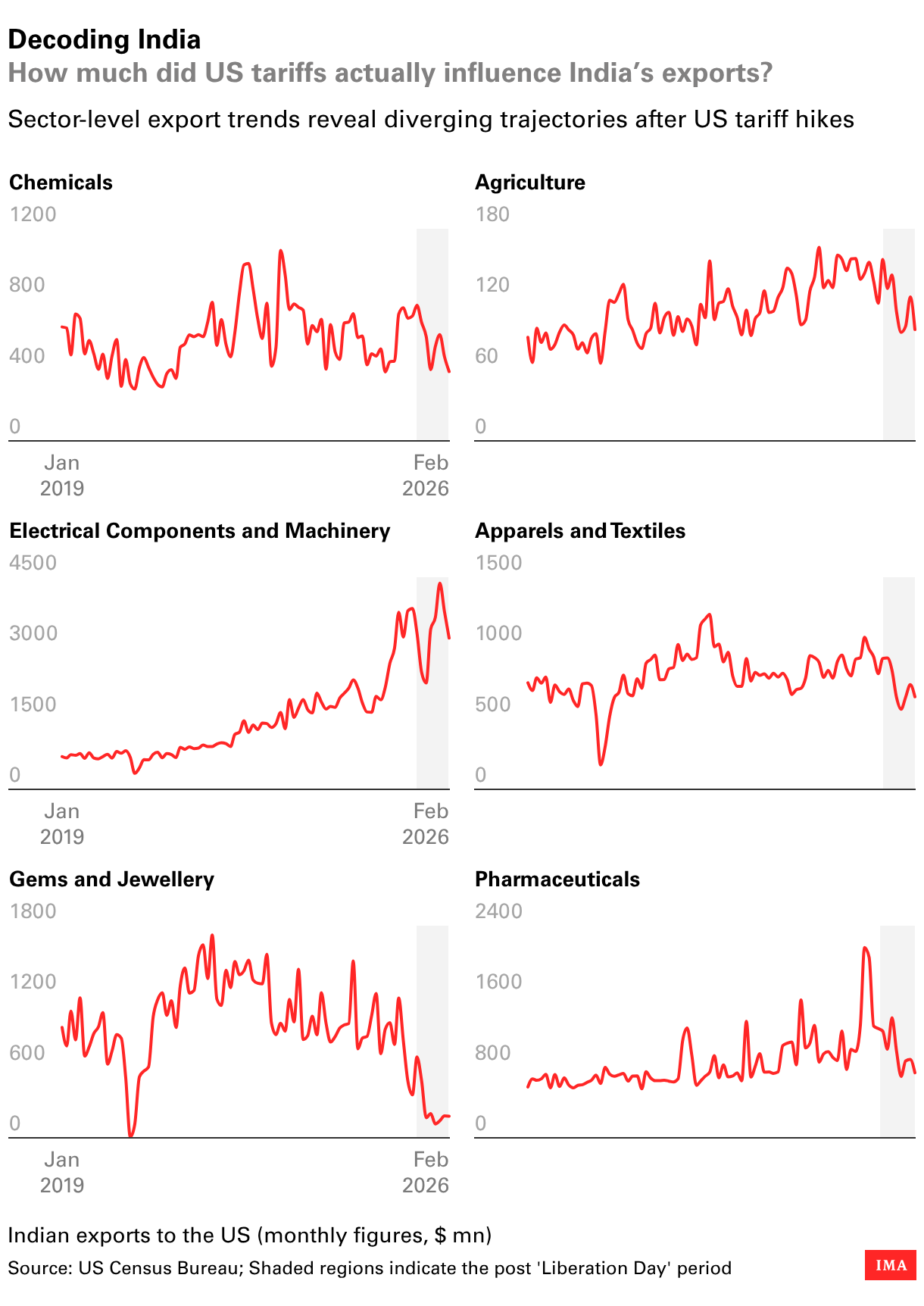
Data on India's exports to the US since Donald Trump's imposition of tariffs early last year reveals a fragmented picture, one where the impact of US trade policy was real in some sectors, negligible in others and often secondary to deeper structural forces in yet others. Taken together, the data suggests that the tariff hikes were neither the primary driver of decline where exports fell, nor the reason for growth where they rose. Rather, structural, macroeconomic and sector-specific factors have dominated in nearly every case.
Gems and Jewellery: Bore the sharpest blow: imports from India to the US fell 80% year-on-year between July and December 2025. The sector was already weakened by the rise of lab-grown diamonds, soaring gold prices and shifting consumer preferences. Tariffs only compounded an existing structural decline.
Pharmaceuticals: Remained largely insulated. 90% of Indian imports are generics, which are explicitly exempted from tariff action; dips in the period tracked US pricing pressures and inventory cycles far more than policy shifts.
Electrical Components and Machinery: Imports from India to the US surged sharply in early 2025, driven by China-plus-one strategies and supply chain realignments. US tariffs on China functioned as a tailwind rather than a headwind.
Chemicals: Followed their usual cyclical pattern tied to global demand shocks and supply chain realignments; limited sensitivity to bilateral tariff changes in the short term.
Apparels and Textiles: Range-bound across the period. Sector competitiveness is driven more by rivalry with Bangladesh and Vietnam than by US trade policy.
Agriculture: Small in absolute value and highly volatile, consistent with commodity price cycles and seasonal demand rather than policy sensitivity.
View interactive version: https://datawrapper.dwcdn.net/OOgfN/2/
View on Desktop for optimal experience
IMA India’s Decoding India is a data-led series that explores the metrics shaping India’s economic and business landscape, presented through comparative visuals across Indian states or peer economies. The aim is simple: to make India’s progress easier to understand at a glance and to surface insights that matter for decision-makers.