


From Product-Led to Community-Fed
When word of mouth becomes a growth engine
Executive Summary
In collectivist cultures like India, peer networks drive buying behaviour. Social influence plays a bigger role than individual preference in shaping decisions.
Similar trends are visible in other collectivist societies like Japan and South Korea. In these markets, too, group norms and shared behaviours accelerate product adoption.
Community can be a strategic driver of growth. When businesses enable dialogue and peer validation, they unlock more sustainable and cost-effective scale.
Brand communities must be intentionally designed to deliver value. Without clear purpose, active facilitation and investment, they often fail to deliver real value.
Leadership plays a critical role in community-led growth. CXOs must back it with dedicated teams, defined metrics and consistent support across functions.
The world is broadly divided into two groups of countries. One set (mainly in the West) includes individualistic cultures that emphasise autonomy, self-reliance and independent decision-making. In stark contrast, collectivist societies like India, Japan, South Korea and China are shaped by interdependence, group identity and social norms. While often seen as cultural traits in personal life, these patterns have deep implications for how consumer trust is formed and products are adopted. A growing number of Indian businesses tap into the same collective instincts to build trust and scale.
For most businesses, growth means scale: more performance marketing, more SKUs, more channels. But in India, a quiet shift is underway, challenging the primacy of ad budgets and embracing something more enduring: community. A new generation of startups and MSMEs is discovering that the path to growth does not always run through Google and Meta but through WhatsApp groups, neighbourhood circles and alumni networks, where decisions are shaped not by algorithms but by the people we know. Community- led growth (CLG) is emerging as a serious strategy. This paper explores why India is uniquely positioned to lead this shift, how businesses across sectors are building community-first models and what CXOs must do to embed this approach into the core of their strategy.
India’s Cultural Advantage: Why Community Works Better Here
India’s collectivist culture shapes not just relationships but also buying behaviour. Consumer choices here are rarely made in isolation. From WhatsApp family groups to alumni circles and apartment networks, decisions are heavily influenced by peer validation. This dynamic is especially visible in digital commerce. India may have over 800 million internet users, but digital trust remains low. Many first-time buyers are sceptical of advertising and rely on recommendations from people they know. According to a 2023 PwC survey, ~30% of Indian shoppers consult friends, family or colleagues before making a purchase. In such an environment, word of mouth and peer recommendation are not peripheral forces but central to how trust is built and how products spread.
This creates a unique challenge: Ads can raise awareness, but they rarely build conviction. Community, on the other hand, offers a shortcut to trust. When a product or brand is endorsed within a peer group, adoption becomes faster, stickier and more cost-effective. In India, community is not just a marketing layer. It is the bridge between curiosity and conversion.
Collectivism Across Borders: Global Lessons in Community-First Growth
Collectivist cultures share a few distinct consumer behaviours that differentiate them sharply from their individualistic counterparts:
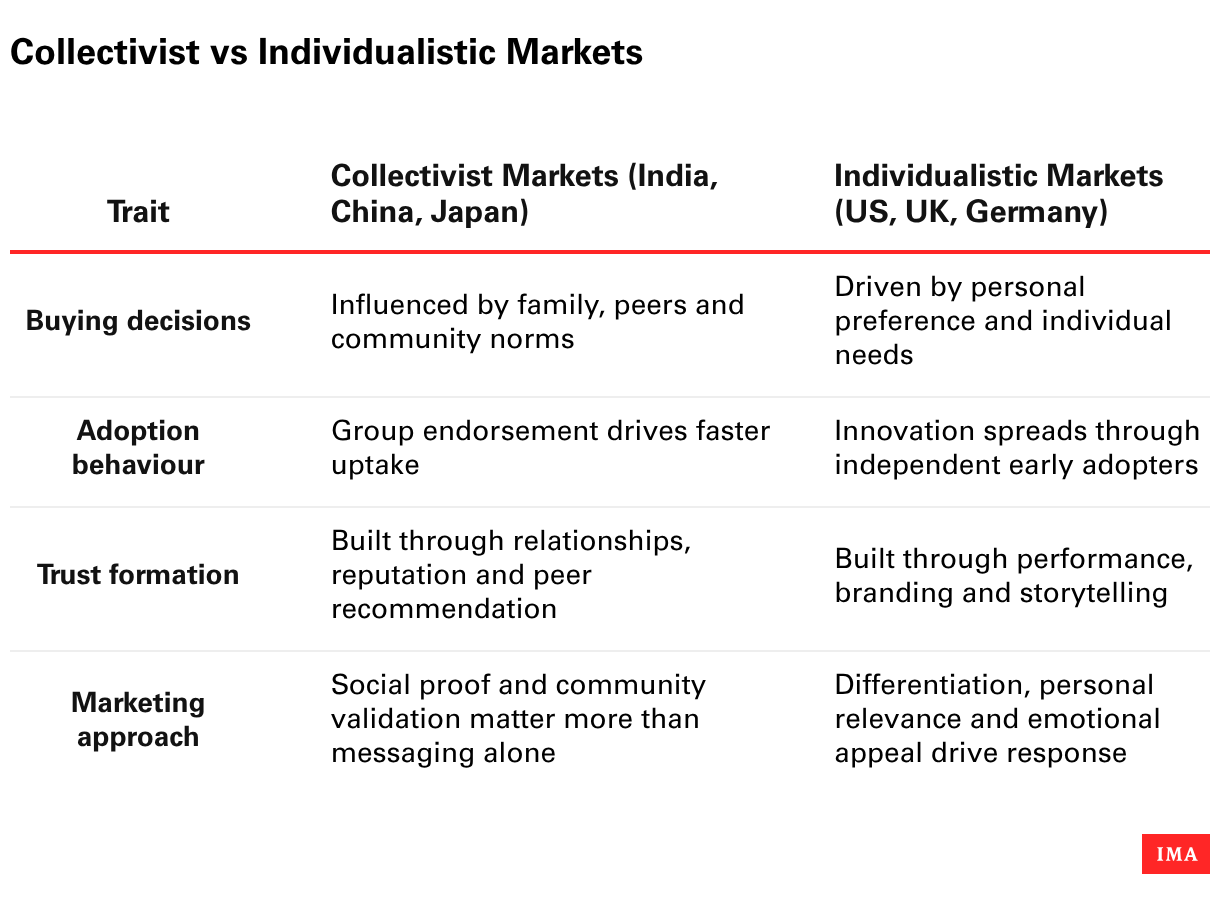
View interactive version: https://datawrapper.dwcdn.net/M69bP/1/
These patterns are grounded in decades of global research on cultural behaviour and consumer psychology - from Hofstede’s work on collectivism to models of social adoption by thinkers like Everett Rogers and Edward Hall. But the real-world insight is simple: people trust people they know. These behaviours make collectivist societies especially receptive to community-led strategies. Consider, for instance, the following examples:
Japan: Nestlé Kit-Kats and the Coffee Movement
In the early 1970s, facing resistance to coffee adoption in a tea-loving culture, Nestlé took a long-term view. Realising that consumers lacked early emotional associations with coffee, it introduced coffeeflavoured Kit-Kats that helped build familiarity with coffee’s smell and taste from childhood. By embedding the taste within shared settings such as school snacks, family rituals and gifting traditions, it used the collectivist value of shared behaviour to shift preferences. What might have taken root slowly in a more individualistic society scaled quickly in Japan because behavioural change was normalised at a group level. Over time, the flavour became familiar not just to children but to their parents too, laying the cultural groundwork for coffee to flourish
South Korea: KakaoTalk and Social Ecosystems
More than a product success, KakaoTalk’s explosive growth in South Korea was a cultural phenomenon. The messaging app leveraged Korea’s tight-knit friend and family networks to expand virally. Features like shared calendars, gaming, shopping and payments were layered onto the social graph, making KakaoTalk a shared environment. Users pulled others into the app ecosystem, not through referral coupons, but through cultural inclusion and peer expectation.
China: Pinduoduo’s Group Buying Revolution
In China, Pinduoduo turned guanxi (social relationships) into a business model. The app offered discounts based on how many people joined a group purchase. Friends invited friends, families coordinated orders and entire social circles became part of the buying journey. Analysts emphasise that Pinduoduo succeeded particularly in lower-tier Chinese cities where collectivist norms and social sharing hugely influence buying behaviour. Pinduoduo’s success showcases how collectivist values can reshape even the most transactional behaviour (e-Commerce) into a social act.
Turning Trust into Growth: Lessons from India’s Community-First Brands
In India too, a host of dynamic brands are showing how community can be transformed from a feel-good idea into a serious growth engine.
D2C personal care brand Mamaearth was among the first to recognise the power of parenting groups on Facebook and WhatsApp. Rather than pushing products through paid ads alone, it nurtured genuine dialogue among new mothers about baby care, skin concerns and nutrition. The brand listened, participated and responded. In doing so, it built a loyal base of users who became co-creators and advocates. This peer-led engagement became a living feedback loop that guided product innovation, surfaced testimonials and fuelled organic growth.
Meesho built its early growth by activating grassroots trust networks across tier 2 and 3 India. Rather than relying on advertising, the platform enabled women to become resellers through WhatsApp and Facebook groups, selling directly to friends, neighbours and family. This peer-topeer model turned everyday users into advocates and sellers, driving organic adoption through social trust. By embedding commerce into familiar community circles, Meesho scaled rapidly, not through media spends, but through word of mouth.
The Whole Truth, a clean-label food startup, built trust not through a formal community but by making transparency its core message. Instead of pushing products, it focused on demystifying food labels and exposing misleading claims around packaged food. Through founder-led videos, blog posts and myth-busting content, it positioned itself as a relatable guide. This honesty resonated with consumers, especially health-conscious millennials, who began to share and endorse the brand organically. By educating rather than advertising, The Whole Truth converted awareness into advocacy and turned its content into a quiet but powerful engine for word-ofmouth growth.
Online forums are often seen as post-purchase tools but brands like Samsung and OnePlus use them to influence purchase decisions as well. Tech enthusiasts and first-time buyers frequently consult forums to resolve doubts, compare features and read reviews by real users. OnePlus has created exclusivity and buzz through its community, launching new features to forum members first and inviting them to participate in product design through meetups. This converts passive interest into active loyalty and fuels new user growth without spending heavily on traditional advertising.
Royal Enfield’s loyal community of riders acts as a living advertisement for the brand. New or aspiring riders often join rides or forums to learn from existing owners, whose experiences, advice and enthusiasm often lead to conversions. Group rides and user-generated content on social platforms build aspirational value, especially among young, urban buyers. The trust and pride shared in these circles turn satisfied customers into brand evangelists. In this way, community acts as a decentralised acquisition engine that reaches potential buyers more credibly than paid campaigns.
Airbnb grew in India by building trust through referrals and community-led credibility. Its structured referral programme helped turn users into advocates, fuelling organic adoption. A 2022 study in The Journal of Travel Research shows that trust, authenticity and peer recommendation play a central role in Indian travellers’ use of Airbnb. The brand also partnered with SHEROES, a 24-million-strong women’s network, to onboard and train female hosts through community engagement. By focusing on real stories, user experiences and peer networks, Airbnb turned travellers and hosts into promoters, allowing the brand to scale through word of mouth and social proof.
Targeting urban professional women, Leap Club built an invite-only platform that seamlessly blended content, community and commerce. Its curated approach, from expert panels to peerled learning groups, created a sense of exclusivity and belonging. Members did not just buy products. They became part of a tribe that shared values and aspirations. Commerce became the by-product of connection.
Even B2B players are discovering the power of curated communities. To (perhaps shamelessly!) cite our own example, IMA India operates closed-door peer forums for CXOs. These confidential, content-rich gatherings offer something no algorithm can replicate: trust. Members engage not because they are marketed to but because they find value in peer exchange, contextual insights and long-term relationships. The business model is built not on scale but credibility.
These examples share a common thread. They treat community not as a side project but as strategic infrastructure. The outcome is not engagement but embeddedness, a presence within the customer’s trusted circles that no advertisement can buy.
Measuring Community-Led Growth
Unlike performance marketing, where ROI is visible within weeks, community-led growth is a longer game. But when measured correctly, the returns are compelling. Mature CLG companies use a range of metrics that go beyond vanity numbers. Key indicators include:
Engagement depth: Not just views or likes, but active participation in discussions, events or content creation
Referral velocity: The speed and volume at which users organically invite others to the platform
Retention gap: Comparing churn rates between community members and non-members reveals how engagement drives stickiness.
Community conversion rate: The percentage of community participants who convert to paid users or high-LTV customers
When linked to business outcomes, these metrics make a compelling case for investing in CLG.
Common Pitfalls: Where Community Efforts Go Wrong
Despite its promise, CLG is often misunderstood. Many companies reduce it to a marketing channel or expect users to generate value with little or no investment. This leads to superficial communities: a large Telegram group with little engagement or an Instagram page with no meaningful dialogue. The truth is that communities require design. They need purpose, structure, moderation and rituals. Brands must offer real value, whether that is learning, access, recognition or co-creation opportunities. And most importantly, someone needs to own the function. Without a dedicated leader and cross-functional support, community efforts often fizzle out. Another common error is over-centralising control. The best communities thrive when users shape the conversation. That requires companies to let go of traditional command-and-control instincts and allow for organic, sometimes unpredictable, evolution.
What CXOs Can Do
For community to become a real growth engine, it must be embedded across the business. CXOs play a critical role here. First, they should appoint a Head of Community, not buried inside marketing but with visibility across product, customer success and content. Second, they can define CLG metrics and include them in core dashboards alongside CAC and LTV. Third, they could allocate budgets not just for tools but for moderators, events, content and rituals. Finally, product and community teams must work together to involve users in co-creation, early access and beta testing.
But beyond structure and strategy lies a deeper truth: in collectivist societies, trust is shaped by peers, not promotions. Community-led growth reflects a cultural shift in how influence travels. From WhatsApp groups in Delhi to KakaoTalk threads in Seoul, growth is no longer individualistic, but communal. At the end of the day, community is not a channel but an ecosystem – one that compounds over time if nurtured with intention. The most successful brands of the next decade will not be those with the loudest campaigns but those with the strongest communities. For CXOs, the opportunity is clear: instead of just products, build tribes.